CNC Turning vs. Milling: What Is the Difference and Which Process Should You Choose?
Understanding the Right CNC Machining Process for Your Custom Parts
CNC machining is widely used to manufacture precision metal and mechanical components, but not every CNC machining process works in the same way. Two of the most common processes are CNC Turning and CNC Milling.
For engineers and purchasing professionals, understanding the difference between CNC turning and CNC milling can help determine a suitable manufacturing approach for a custom component.
The simplest distinction is:
CNC Turning rotates the workpiece while the cutting tool removes material. CNC Milling generally holds the workpiece in position while rotating cutting tools remove material from different directions.
However, selecting the right process involves more than deciding whether a component is round or rectangular. Part geometry, dimensions, tolerances, material, holes, grooves, threads, production quantity, secondary operations, and inspection requirements may all influence the manufacturing solution.
A-Corn supports international OEM/ODM customers with drawing-based manufacturing evaluation and Taiwan supply chain coordination. Customers can provide drawings and specifications, and the manufacturing process can be evaluated according to the actual component requirements.

What Is CNC Turning?
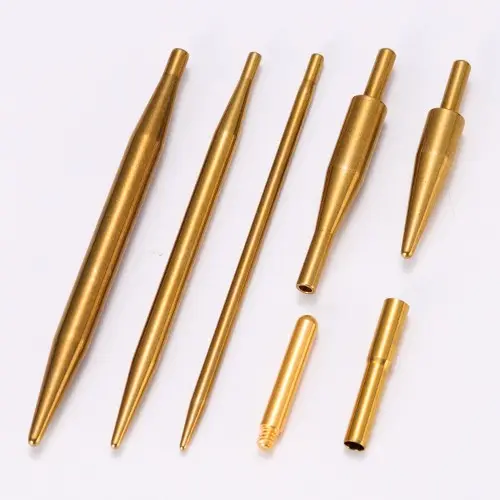
CNC Turning is a subtractive manufacturing process commonly used to produce cylindrical, round, or rotationally symmetrical components.
During the turning process, the workpiece rotates while a cutting tool removes material to create the required geometry.
This process is commonly associated with components such as:
| Typical CNC Turned Components | Common Features |
| Precision Pins | Straight or stepped diameters |
| Precision Shafts | Multiple diameters and shoulders |
| Contact Pins | Small cylindrical features and grooves |
| Sleeves | OD/ID and cylindrical geometry |
| Bushings | Internal and external diameters |
| Spacers | Controlled length and diameter |
| Rings | OD, ID and thickness requirements |
| Threaded Components | External or internal threads |
| Custom Turned Parts | Drawing-specific rotational features |
CNC turning can produce more than a simple round shaft. Depending on the component design and available manufacturing resources, turned parts may contain steps, shoulders, grooves, threads, tapers, holes, and other precision features.

What Is CNC Milling?
CNC Milling is another subtractive machining process. Unlike turning, where the workpiece itself rotates, milling primarily uses a rotating cutting tool to remove material from a workpiece.
The cutting tool can approach different surfaces and create features such as flat faces, pockets, slots, holes, contours, and complex profiles.
Typical CNC milled components may include:
| Typical CNC Milled Components | Common Features |
| Machined Blocks | Multiple flat surfaces |
| Plates | Faces, holes and mounting features |
| Brackets | Holes, slots and complex profiles |
| Housings | Pockets, cavities and mounting surfaces |
| Machine Components | Multi-surface machining |
| Equipment Parts | Custom holes, slots and contours |
| Custom Metal Components | Drawing-specific complex geometry |
CNC milling is therefore commonly considered when a component requires machining on several surfaces or contains geometries that cannot be produced efficiently by turning alone.
CNC Turning vs. CNC Milling
Although both processes remove material using computer-controlled machining equipment, their machining principles and suitable component geometries are different.
| Comparison | CNC Turning | CNC Milling |
| Main Motion | Workpiece rotates | Cutting tool rotates |
| Typical Geometry | Cylindrical / rotational | Flat / prismatic / complex |
| Common Parts | Pins, shafts, sleeves, bushings | Blocks, plates, brackets, housings |
| Diameter Features | Particularly suitable | Can be machined when required |
| Flat Surfaces | Secondary features possible | Highly suitable |
| Grooves | Common on turned geometry | Suitable for various groove designs |
| Pockets | Limited by turning geometry | Common milling feature |
| Holes | Axial or other features depending on process | Multiple positions and orientations |
| Threads | Internal/external turning possible | Thread machining also possible |
| Multi-Surface Features | May require additional operations | Well suited to multi-face machining |
| Best Starting Point | Round bar / rotational part | Block, plate or other workpiece geometry |
This table should be treated as a general manufacturing guide rather than an absolute rule. Modern CNC equipment can combine multiple machining operations, and some components may require both turning and milling.

When Should You Choose CNC Turning?
CNC turning is usually a logical starting point when the majority of the component is based around a central axis.
For example, a drawing showing a long cylindrical component with several different diameters, shoulders, grooves and external threads is likely to have strong turning characteristics.
CNC Turning may be suitable when:
The component is primarily cylindrical.
Most critical dimensions are diameters.
The design includes multiple stepped diameters.
Concentric features are important.
The component contains shoulders or circumferential grooves.
The part resembles a pin, shaft, sleeve, ring or bushing.
External or internal threads are required on rotational features.
Repeatable production of turned geometry is required.
A Precision Shaft, for example, may have three or four different diameters along its length. CNC turning allows these features to be produced relative to the component's rotational axis.
Similarly, a Precision Contact Pin may contain a small diameter, shoulder, groove, tip geometry and other rotational features.
For these types of components, turning is often an appropriate process to evaluate first.
When Should You Choose CNC Milling?
CNC milling is generally more suitable when the component is dominated by flat surfaces, multiple faces, pockets, slots, complex contours or holes positioned at different locations.
CNC Milling may be suitable when:
The component is primarily rectangular, square or irregular in shape.
Multiple flat surfaces need machining.
Pockets or cavities are required.
Slots or channels are part of the design.
Holes are positioned on different surfaces.
Complex external profiles are required.
A housing, bracket, plate or block needs precision machining.
Several features must be machined from different directions.
For example, an equipment bracket may require a flat mounting surface, multiple bolt holes, slots and a contoured outside profile. These characteristics generally make CNC milling more relevant than conventional turning.
Can One Component Require Both Turning and Milling?
Yes.
This is particularly important when evaluating modern precision components.
A component may be predominantly cylindrical and therefore start with CNC turning, but the drawing may also require:
In such cases, additional milling or other machining operations may be required.
For example, consider a precision shaft with several turned diameters and shoulders, plus a flat section and cross hole.
The cylindrical features may be produced through turning, while the flat and cross-hole features may require additional machining.
Therefore, buyers should avoid assuming that every component must be classified as either 100% turning or 100% milling.
The complete drawing should be evaluated.
How Part Geometry Influences Process Selection
The geometry of a component is one of the first factors considered when determining a manufacturing process.
| Drawing Feature | Process to Evaluate |
| Cylindrical OD | CNC Turning |
| Multiple Stepped Diameters | CNC Turning |
| Long Shaft Geometry | CNC Turning |
| Sleeve / Bushing Geometry | CNC Turning |
| Circumferential Groove | CNC Turning |
| Flat Surface | CNC Milling |
| Pocket / Cavity | CNC Milling |
| Slot | CNC Milling |
| Complex External Profile | CNC Milling |
| Multiple Face Features | CNC Milling |
| Turned Shaft + Cross Hole | Turning + Additional Machining |
| Cylindrical Part + Flats | Turning + Milling may be considered |
This type of analysis is more useful than selecting a process based only on the product name.
Material Selection for CNC Turning and Milling
Both CNC turning and CNC milling can be applied to many engineering materials, but machinability and process requirements vary significantly by material and component design.
Common material categories used for CNC machined components may include:
A-Corn does not need to restrict customers to a fixed list of material grades.
Instead, customers can specify the required material directly on their engineering drawings or RFQ documents. Suitable material and manufacturing resources in Taiwan can then be evaluated according to the project requirements.
Material selection should consider not only machinability but also the component's mechanical requirements, operating environment, corrosion resistance, wear conditions, weight, surface treatment, and cost objectives.
Tolerance and Surface Finish Considerations
The question should not only be:
“Turning or milling?”
It should also be:
“Which dimensions are critical?”
A drawing may contain general dimensions as well as critical dimensions requiring tighter control.
Before manufacturing evaluation, customers should clearly identify requirements such as:
| Requirement | Information to Provide |
| Critical Dimensions | Identify important dimensions on drawing |
| Dimensional Tolerance | Specify required tolerance |
| Geometric Requirements | According to drawing requirements |
| Surface Finish | Specify where functionally required |
| Threads | Size, type and tolerance requirements |
| Mating Features | Identify related assembly components |
| Inspection | Specify critical inspection requirements |
Adding unnecessary tight tolerances to every feature may increase manufacturing complexity and cost. It is therefore helpful to distinguish functional critical dimensions from general dimensions.

CNC Turning vs. Milling: Which Is More Cost-Effective?
There is no universal answer.
Manufacturing cost depends on factors such as:
Material + Geometry + Dimensions + Tolerance + Machining Time + Tooling + Secondary Processes + Quantity + Inspection + Surface Treatment
A simple cylindrical component may be more efficiently produced using a turning process, while a multi-surface component may be more suitable for milling.
However, a highly complex turned component requiring multiple secondary operations may not necessarily be less expensive than a milled component.
For OEM/ODM sourcing, the better question is:
Which manufacturing process can achieve the required function, quality and production quantity efficiently?
This is why providing a complete engineering drawing is important when requesting a quotation.

How to Choose Between CNC Turning and Milling
Before requesting a quote, purchasing and engineering teams can review these questions:
| Question | Why It Matters |
| Is the component primarily round or cylindrical? | Turning may be the starting process |
| Does it require multiple flat surfaces? | Milling may be more suitable |
| Are most critical dimensions diameters? | Turning may be preferred |
| Are pockets and slots required? | Milling may be required |
| Are there cross holes or flats on a shaft? | Combined operations may be needed |
| What material is specified? | Influences machining strategy |
| Which tolerances are critical? | Influences process and inspection |
| Is surface treatment required? | May require secondary processing |
| What is the order quantity? | Influences production planning |
| Are special inspections required? | Should be evaluated before quotation |
For complex components, customers do not necessarily need to determine the manufacturing process themselves.
Providing a complete drawing allows the manufacturing requirements to be evaluated more accurately.

From Your Drawing to a Manufacturing Solution
A-Corn supports a drawing-based project workflow for international OEM/ODM customers.
| Step | Process | Description |
| 01 | Send Your Drawing | Provide 2D/3D drawings, samples or technical specifications |
| 02 | Requirement Review | Review geometry, material, dimensions, tolerances and quantity |
| 03 | Process Evaluation | Evaluate turning, milling or other appropriate manufacturing processes |
| 04 | Taiwan Supplier Coordination | Identify suitable manufacturing resources according to project requirements |
| 05 | Quality Inspection | Coordinate agreed dimensional and quality requirements |
| 06 | Production & Delivery | Coordinate production schedule and delivery requirements |
Why Work with A-Corn for Custom CNC Machined Parts?
A-Corn's role is not limited to supplying one standard type of CNC component.
For international customers sourcing customized mechanical parts, different projects may require different materials, machining equipment, secondary operations and supplier capabilities.
A-Corn helps coordinate these requirements through its Taiwan manufacturing network.
| A-Corn Support | Customer Benefit |
| Drawing-Based Evaluation | Manufacturing is evaluated according to actual component requirements |
| CNC Turning Sourcing | Suitable resources for turned components |
| CNC Milling Sourcing | Suitable resources for milled components |
| Flexible Material Sourcing | Not restricted to a single fixed material list |
| Multi-Process Coordination | Different manufacturing processes can be evaluated together |
| Secondary Process Coordination | Finishing and additional processes can be considered |
| Quality Coordination | Critical requirements can be defined according to drawings |
| Taiwan Supply Network | International buyers gain access to suitable Taiwan manufacturing resources |
FAQ – CNC Turning vs. Milling
1. What is the main difference between CNC turning and CNC milling?
The main difference is the machining motion. In CNC turning, the workpiece rotates while a cutting tool removes material. In CNC milling, rotating cutting tools remove material from a workpiece to create flat surfaces, pockets, slots, holes and complex geometries.
2. Is CNC turning only used for simple round parts?
No. CNC turning can produce components with stepped diameters, shoulders, grooves, threads, tapers and other detailed rotational features.
3. What types of parts are suitable for CNC turning?
Typical examples include precision pins, shafts, sleeves, bushings, rings, spacers and other cylindrical or rotationally symmetrical components.
4. What types of parts are suitable for CNC milling?
CNC milling is commonly used for blocks, plates, brackets, housings and components requiring flat surfaces, pockets, slots, holes or complex multi-surface geometries.
5. Can turning and milling be used on the same component?
Yes. Some components contain both rotational and non-rotational features. A shaft, for example, may require turned diameters plus milled flats, slots or cross holes.
6. Is CNC turning cheaper than CNC milling?
Not necessarily. Cost depends on component geometry, material, tolerance, machining time, quantity, tooling, secondary processes, inspection and other requirements.
7. Which process is better for precision shafts?
If a shaft is primarily cylindrical with multiple diameters, shoulders and grooves, CNC turning is generally an appropriate process to evaluate. Additional machining may be required if the shaft also contains flats, slots or other non-rotational features.
8. Which process is better for housings?
It depends on the housing geometry. Cylindrical sleeves and housings may be suitable for turning, while housings containing multiple flat surfaces, pockets or complex features may require milling.
9. Do I need to decide whether my component requires turning or milling before requesting a quote?
No. Providing a complete engineering drawing is usually more important. A-Corn can evaluate the geometry and coordinate suitable Taiwan manufacturing resources according to the project requirements.
10. What should I provide for a CNC machining quotation?
For an efficient evaluation, provide:
2D/3D Drawing + Material + Dimensions + Critical Tolerances + Surface Finish + Quantity + Application + Inspection Requirements + Delivery Requirements
Need Help Choosing CNC Turning or Milling?
Send Your Drawing to A-Corn
If you are unsure whether your component should be manufactured by CNC Turning, CNC Milling, or a combination of processes, send us your drawing and project requirements.
A-Corn can help evaluate the component requirements and coordinate suitable manufacturing resources in Taiwan.
Send Your Drawing | Request a Quote | Contact A-Corn


