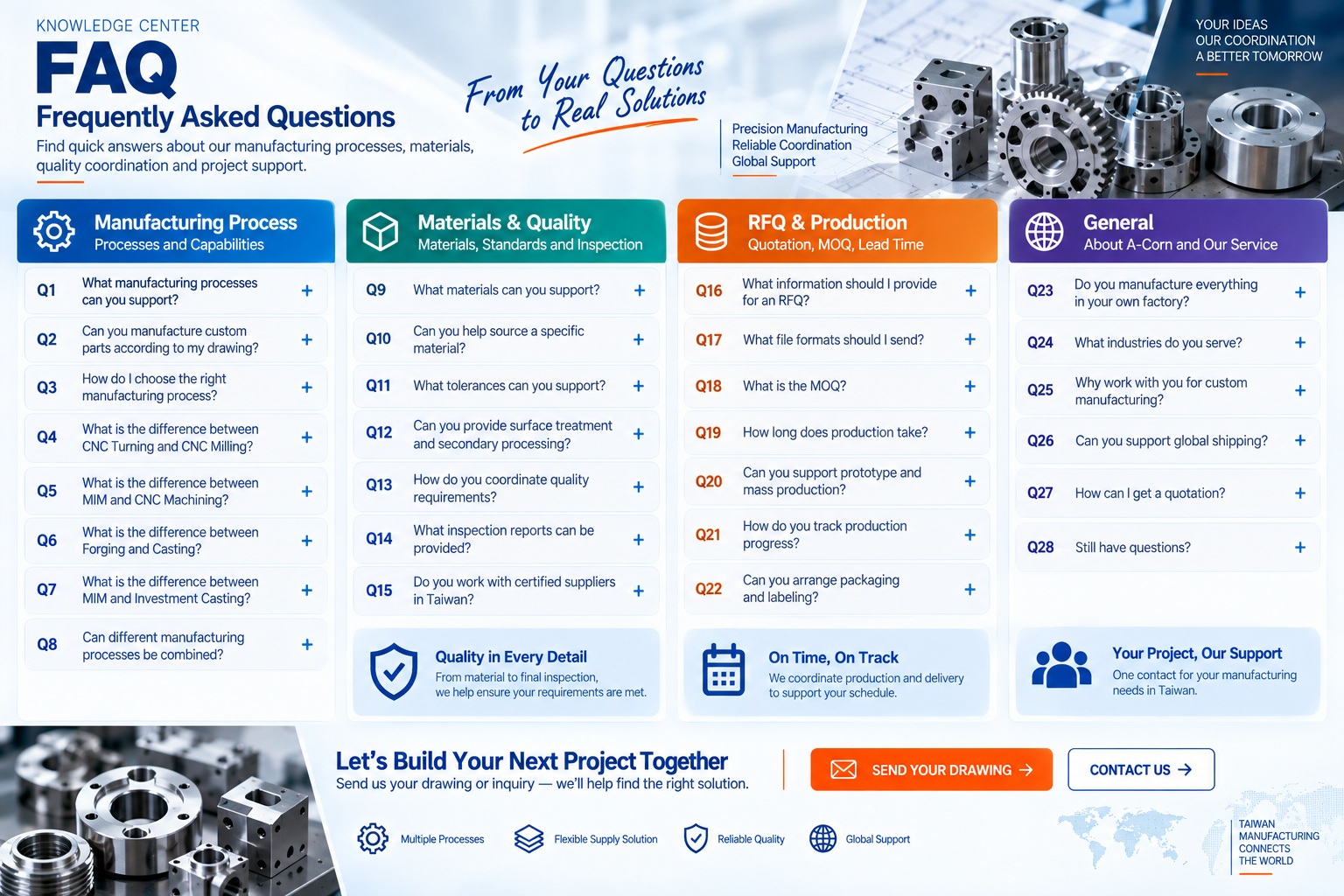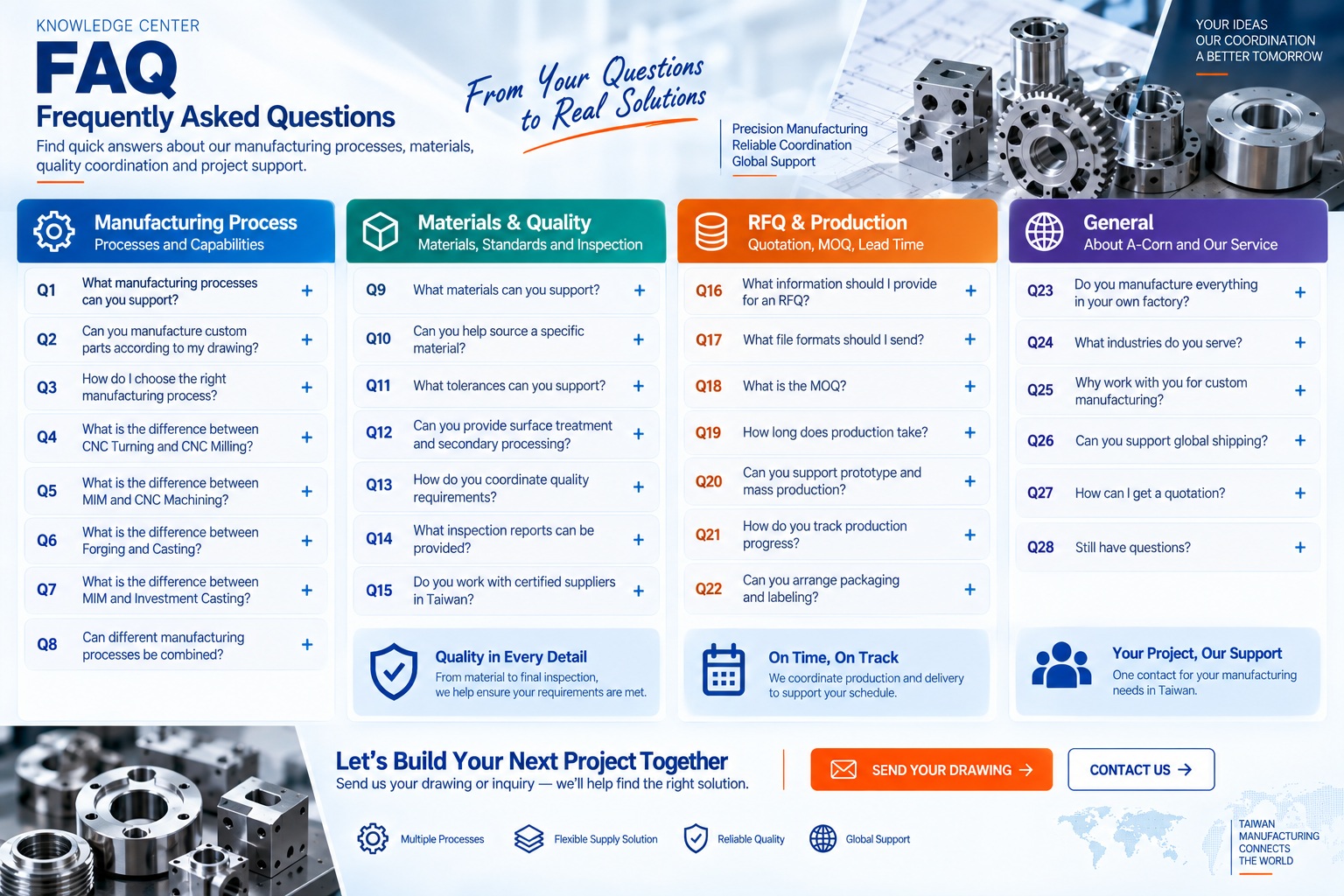
Manufacturing FAQ
Frequently Asked Questions About Custom Precision Manufacturing
Looking for the right manufacturing process, material, or supplier for your custom metal parts? Below are answers to common questions about CNC machining, MIM, forging, investment casting, precision stamping, material sourcing, quality coordination, and OEM/ODM manufacturing.

1. What manufacturing processes can A-Corn support?
A-Corn supports custom manufacturing projects based on customer drawings and specifications. Depending on project requirements, manufacturing solutions may involve CNC Turning, CNC Milling, Metal Injection Molding (MIM), Forging, Investment Casting, Precision Stamping, Powder Metallurgy, and related secondary processes.
The appropriate manufacturing process is evaluated according to part geometry, material, tolerance, quantity, application, and other project requirements.
2. Can A-Corn manufacture custom parts according to my drawing?
Yes. A-Corn supports drawing-based custom manufacturing projects.
Customers can provide available 2D drawings, 3D models, material requirements, tolerances, quantities, surface treatment requirements, and application information for project evaluation.
Send Your Drawing → Engineering Review → Manufacturing Evaluation → Production Coordination
3. How do I choose the right manufacturing process for my part?
The appropriate process depends on several factors, including:
Part Geometry|Material|Tolerance|Quantity|Surface Requirements|Application|Secondary Processing
For example, CNC turning is commonly considered for cylindrical parts such as pins, shafts, sleeves, and spacers, while CNC milling is commonly considered for housings, brackets, plates, blocks, and multi-surface components.
MIM, forging, casting, stamping, or a combination of processes may also be evaluated depending on the project.
4. What is the difference between CNC Turning and CNC Milling?
CNC Turning generally rotates the workpiece while cutting tools remove material. It is commonly used for cylindrical components such as shafts, pins, sleeves, rings, and spacers.
CNC Milling uses rotating cutting tools to remove material from a controlled workpiece and is commonly used for blocks, housings, brackets, plates, pockets, and complex machined components.
Some parts may require both turning and milling operations.
Learn More: CNC Turning vs. CNC Milling →
5. What is the difference between MIM and CNC Machining?
Metal Injection Molding (MIM) uses metal-powder feedstock that is molded, debound, and sintered to produce metal components. It may be considered for certain relatively small, geometrically complex parts and repeat production requirements.
CNC machining starts with solid material and removes material using computer-controlled cutting tools. It can provide flexibility for prototypes, design changes, and many precision features.
The appropriate choice depends on geometry, material, tolerance, production quantity, tooling, and cost considerations.
Learn More: MIM vs. CNC Machining →
6. What is the difference between Forging and Casting?
Forging shapes metal using compressive force, while casting generally involves introducing molten metal into a mold and allowing it to solidify.
Forging may be evaluated for certain structurally demanding components, while casting may offer advantages for certain complex geometries.
Neither process is universally better. The appropriate method depends on the component design, material, performance requirements, quantity, and secondary machining requirements.
Learn More: Forging vs. Casting →
7. What is the difference between MIM and Investment Casting?
MIM and investment casting can both be considered for complex metal components, but their manufacturing principles are different.
MIM uses metal-powder feedstock with injection molding, debinding, and sintering. Investment casting uses a pattern and ceramic shell process followed by molten metal casting.
Part size, geometry, material, quantity, tooling, tolerance, and secondary operations should all be considered when selecting between the two processes.
Learn More: MIM vs. Investment Casting →
8. What materials can A-Corn support?
A-Corn is not limited to a single fixed list of material grades.
Material requirements can be evaluated according to customer drawings, specifications, mechanical requirements, corrosion resistance, wear resistance, machinability, surface treatment, and application.
Depending on the project, A-Corn can assist with material and supplier sourcing through its Taiwan manufacturing network.
9. Can A-Corn help source a specific material?
Yes. If your drawing specifies a particular material or material requirement, A-Corn can evaluate sourcing options according to the project.
Please provide the material specification together with the drawing, quantity, application, and any special requirements when requesting a quotation.
Material availability should be confirmed on a project-by-project basis.
10. Does A-Corn provide prototype and mass-production support?
A-Corn can evaluate projects according to different production stages, including prototype, trial production, small-batch requirements, and repeat production.
The suitable manufacturing process may change as the project develops.
For example:
Prototype → Design Validation → Trial Production → Mass Production
Quantity information is therefore important when evaluating the manufacturing route.
11. What tolerances can A-Corn support?
Tolerance capability depends on the manufacturing process, material, geometry, part size, machine setup, secondary operations, and inspection requirements.
Rather than applying one tolerance value to every product, A-Corn recommends identifying the critical dimensions and required tolerances directly on the drawing for manufacturing evaluation.
12. Can different manufacturing processes be combined?
Yes. Many custom components require more than one manufacturing process.
For example:
Forging → CNC Machining → Heat Treatment → Surface Treatment → Inspection
or
MIM → Sintering → CNC Machining → Surface Treatment → Inspection
A-Corn can help coordinate suitable manufacturing and secondary processes according to individual project requirements.
13. Can A-Corn provide surface treatment and secondary processing?
Surface treatment and secondary processing can be evaluated according to project requirements.
Depending on the component, these may include machining, heat treatment, grinding, polishing, plating, coating, deburring, or other required operations.
Please specify the required finish or treatment on your drawing or RFQ documentation whenever possible.
14. How does A-Corn coordinate quality requirements?
Quality coordination begins with understanding the customer's drawing and specifications.
Key considerations may include:
Drawing Review → Material Requirements → Critical Dimensions → Process Requirements → Inspection Requirements → Production Coordination
Inspection requirements should be defined according to the individual project and customer specifications.
15. Does A-Corn manufacture everything in its own factory?
A-Corn's manufacturing solution model includes coordination with manufacturing resources in Taiwan.
Based on each customer's drawing, material, process, quantity, and application requirements, A-Corn helps evaluate and coordinate suitable manufacturing resources and secondary processes.
This allows international customers to work through a single project contact while accessing different manufacturing capabilities in Taiwan.
16. What information should I provide for an RFQ?
For a more effective manufacturing evaluation, please provide as much of the following information as possible:
| RFQ Information | Details |
| Drawing | 2D Drawing / 3D Model |
| Material | Required material or specification |
| Dimensions | Overall and critical dimensions |
| Tolerance | Critical tolerance requirements |
| Quantity | Prototype / Order Quantity / Annual Volume |
| Surface Treatment | Plating, coating, polishing, etc. |
| Heat Treatment | If required |
| Inspection | Special inspection requirements |
| Application | Intended use of the component |
| Delivery | Required destination or schedule |
If some information is not yet finalized, it can be discussed during project evaluation.
17. What file formats should I send for a quotation?
Please provide the available 2D drawing and/or 3D model together with your project specifications.
If specific file-format requirements apply to your project, please contact A-Corn before submission.
18. What is A-Corn's MOQ?
MOQ depends on the manufacturing process, tooling requirements, material, part geometry, and supplier conditions.
Instead of applying one MOQ to every product, A-Corn evaluates quantity requirements on a project-by-project basis.
Please provide your initial order quantity and estimated annual volume when requesting a quotation.
19. How long does production take?
Lead time depends on factors such as material availability, tooling, manufacturing process, part complexity, quantity, secondary processing, inspection, and delivery requirements.
A production schedule should therefore be confirmed after the drawing and complete project requirements have been reviewed.
20. Why work with A-Corn for custom manufacturing projects?
A-Corn has served international customers since 1984 and supports custom manufacturing projects through a Taiwan-based supply network.
Our approach focuses on:
Drawing-Based Evaluation
Flexible Material Sourcing
Multiple Manufacturing Processes
Taiwan Supply Network
Quality & Project Coordination
International OEM/ODM Support
Our goal is to help customers move from a drawing and manufacturing requirement toward a practical production solution.
Still Have Questions About Your Project?
Every custom component has different requirements.
Send us your drawing, material requirement, quantity, tolerance, surface treatment, and application information for project evaluation.
From Your Drawing to a Suitable Manufacturing Solution
CNC Turning | CNC Milling | MIM | Forging | Investment Casting | Precision Stamping
SEND YOUR DRAWING →
REQUEST A QUOTE →