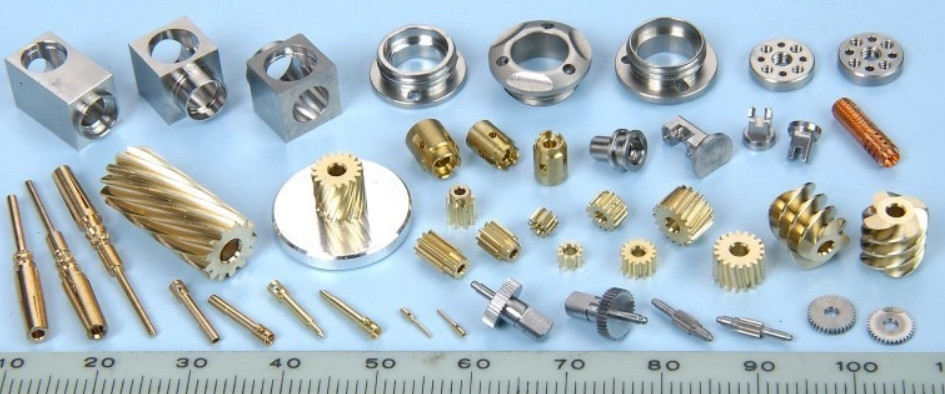
MIM vs. CNC Machining: What Is the Difference and Which Process Should You Choose?
Metal Injection Molding (MIM) and CNC machining are two very different manufacturing methods for producing precision metal components.
Both processes can be used to manufacture custom metal parts, but they differ significantly in how parts are formed, the types of geometry they can produce, tooling requirements, production volume, material considerations, dimensional control, and overall manufacturing economics.
MIM forms components using a feedstock consisting of fine metal powder and binder. The material is injection molded into the required shape, followed by debinding and sintering.
CNC machining, on the other hand, starts with solid material and removes material through controlled cutting operations such as CNC turning and CNC milling.
Therefore, the question should not simply be:
“Is MIM better than CNC machining?”
A more useful question is:
“Which process is more suitable for my part geometry, material, tolerance, quantity, application, and production requirements?”
A-Corn Enterprises Co., Ltd. supports international OEM/ODM customers by reviewing drawings and specifications and coordinating suitable manufacturing resources through its Taiwan supply network.


What Is Metal Injection Molding (MIM)?
Metal Injection Molding combines principles of plastic injection molding with powder metallurgy.
A simplified MIM manufacturing process can be described as:
Metal Powder + Binder → Feedstock → Injection Molding → Debinding → Sintering → Secondary Processing → Inspection
The metal powder is mixed with a binder system to create a moldable feedstock.
This feedstock is injected into a mold cavity to form the required geometry. After molding, the binder is removed through a debinding process.
The component is then sintered at controlled temperatures so that the metal particles bond and densify.
Depending on the component requirements, additional operations may follow, including:
CNC Machining
Grinding
Heat Treatment
Surface Treatment
Polishing
Plating
Inspection
MIM is often evaluated for relatively small metal components with complex geometry and repeat production requirements.
However, the suitability of MIM should always be evaluated according to the actual drawing, material, quantity, dimensional requirements, and application.
What Is CNC Machining?
CNC machining is a subtractive manufacturing process.
Instead of forming a component inside a mold, CNC machining begins with solid material such as bar stock, rod, plate, block, or another suitable material form.
Computer-controlled cutting tools remove material until the required geometry is produced.
Two important CNC machining processes are:
CNC Turning
In CNC turning, the workpiece rotates while cutting tools remove material.
It is commonly considered for components such as:
Pins
Shafts
Sleeves
Bushings
Rings
Spacers
Cylindrical Components
CNC Milling
In CNC milling, rotating cutting tools remove material from a stationary or controlled workpiece.
It is commonly considered for:
Housings
Brackets
Blocks
Plates
Structural Components
Multi-Surface Parts
Complex Machined Components
CNC machining can also be combined with drilling, tapping, threading, grinding, surface treatment, and other secondary processes.
MIM vs. CNC Machining: Key Differences
Factor
MIM
CNC Machining
|
|
|
Manufacturing Principle | Mold metal-powder feedstock, then debind and sinter | Remove material from solid stock |
Tooling | Dedicated tooling normally required | No dedicated molding tool for basic production |
Geometry | Well suited to certain complex small geometries | Highly flexible but affected by tool access |
Internal / Detailed Features | Can be advantageous depending on design | Tool accessibility must be considered |
Material Usage | Near-net-shape process | Material is removed during machining |
Prototype Flexibility | Tooling must be considered | Often suitable for development and lower quantities |
Design Changes | Tooling changes may be required | Program/setup changes may offer more flexibility |
Production Volume | Often evaluated for repeat/higher-volume production | Suitable across many quantities depending on part |
Precision Features | Secondary machining may still be required | Precision features can be machined directly |
Unit Cost | Strongly influenced by tooling and volume | Strongly influenced by machining time and complexity |
The most appropriate process depends on the complete manufacturing requirements rather than any single factor.
When Should You Consider MIM?
MIM may be worth evaluating when several of the following conditions apply.
1. The Part Is Relatively Small and Geometrically Complex
MIM can be particularly useful when a component combines several features into a compact design.
Examples may include:
Multiple Surfaces
Small Holes
Grooves
Bosses
Ribs
Curved Features
Complex Profiles
Integrated Functional Features
The exact manufacturability of each feature still requires engineering evaluation.
2. The Project Requires Repeated Production
Because MIM normally involves tooling, production quantity becomes an important economic consideration.
For suitable projects, the initial tooling investment can be distributed across repeated production quantities.
Therefore, buyers should provide both:
Initial Order Quantity + Estimated Annual Volume
when requesting a manufacturing evaluation.
3. Multiple Machined Features Could Potentially Be Integrated
A part that requires many individual CNC machining operations may be worth evaluating for MIM if its geometry and production quantity are appropriate.
Instead of separately machining multiple features, MIM may allow several geometric features to be incorporated into the molded design.
This does not mean that MIM automatically eliminates CNC machining.
Critical features may still require secondary machining.
4. Material Utilization Is an Important Consideration
CNC machining removes material from solid stock.
For some geometries, this can mean a significant portion of the starting material becomes chips.
MIM is a near-net-shape manufacturing process, so material utilization and the complete production route may differ substantially from CNC machining.
The actual economic benefit depends on part design, material, quantity, and secondary processing requirements.
When Should You Consider CNC Machining?
CNC machining may be worth considering when flexibility, dimensional control, or lower initial tooling requirements are important.
1. Prototype and Development Projects
When a product is still being developed, the design may change several times.
CNC machining can often provide flexibility because changes may be handled through:
CAD / CAM Changes → Programming → Setup → Machining
rather than modifying or replacing dedicated molding tooling.
This can be useful during:
Prototype Development
Engineering Validation
Design Verification
Trial Production
Low-Quantity Orders
2. Tight or Critical Machined Features
CNC machining can be used to directly produce many precision features.
Depending on the component, these may include:
Precision Diameters
Internal Bores
Flat Surfaces
Threads
Grooves
Shoulders
Slots
Pockets
Mounting Surfaces
Mating Features
Actual achievable tolerances depend on material, geometry, machine capability, setup, inspection method, and other manufacturing factors.
3. Lower Production Quantities
If only a limited quantity is required, dedicated MIM tooling may not always be economically justified.
CNC machining may therefore be evaluated when buyers need:
Prototype → Small Batch → Trial Order → Bridge Production
before moving toward larger-scale production.
4. Frequent Design Changes
If the product design is still evolving, CNC machining can provide greater manufacturing flexibility.
A change to a hole position, diameter, groove, length, or other feature may sometimes be implemented by modifying the machining program or setup.
For MIM, a design change may affect tooling.
This should be considered early in product development.
MIM vs. CNC Machining: Geometry Considerations
Part geometry can be one of the strongest factors when choosing between these processes.
Part Feature
MIM
CNC Machining
|
|
|
Small Complex Parts | Often worth evaluating | Possible but machining time may increase |
Pins / Shafts | Possible depending on design | CNC turning often suitable |
Housings / Blocks | Design-dependent | CNC milling often suitable |
Multiple Integrated Features | Can be advantageous | May require multiple operations |
Deep Cavities | Design-dependent | Tool accessibility matters |
Threads | May require secondary operation | Can be machined |
Precision Bores | May require machining | Can be machined directly |
Undercuts | Tooling/design review required | Tool accessibility and setup matter |
Complex 3D Geometry | Potential MIM advantage | Multi-axis machining may be considered |
Frequent Design Changes | Tooling impact | Often more flexible |
This table should be used as a general process-selection guide rather than a universal manufacturing rule.
MIM vs. CNC Machining: Material Selection
Material selection is another critical consideration.
The appropriate material should be determined according to the component's functional requirements rather than selecting a process first and forcing the material to fit it.
Important considerations may include:
Mechanical Strength
What loads will the component experience?
Wear Resistance
Will the part experience repeated contact or friction?
Corrosion Resistance
Will it be exposed to moisture, chemicals, outdoor conditions, or other environments?
Temperature
Will the component operate under elevated or changing temperatures?
Surface Treatment
Does the finished component require plating, coating, polishing, passivation, or another treatment?
Material Availability
Can the specified material be sourced reliably for the required production quantity?
A-Corn is not limited to a fixed list of material grades.
Material selection and sourcing can be evaluated according to the customer's drawing, specifications, application, and manufacturing requirements.
MIM vs. CNC Machining: Which Has Better Tolerance?
There is no useful universal answer such as “CNC is always more precise” or “MIM can always achieve a specific tolerance.”
Tolerance capability depends on:
Component Size
Geometry
Material
Manufacturing Process
Tooling
Sintering Behavior
Machine Setup
Secondary Operations
Inspection Requirements
For MIM parts, certain critical features may require secondary CNC machining after sintering.
For example:
MIM → Sintering → CNC Machining → Inspection
This hybrid approach allows a component to use MIM for overall geometry while using machining for selected critical dimensions.
MIM + CNC Machining: Why the Processes Can Work Together
One of the most important points for engineers and purchasing professionals is that MIM and CNC machining are not necessarily competing processes.
They can complement each other.
A component might be produced using:
MIM → Debinding → Sintering → CNC Turning / Milling → Surface Treatment → Inspection
MIM creates the primary geometry.
CNC machining then finishes selected functional features.
These may include:
Precision Holes
Threads
Bores
Mating Surfaces
Critical Diameters
Sealing Surfaces
Assembly Features
For some projects, this hybrid manufacturing route may provide a suitable balance between geometric complexity and precision requirements.
MIM vs. CNC Machining: Which Is More Cost-Effective?
This is one of the most important purchasing questions.
The answer depends heavily on production quantity and component design.
The complete manufacturing cost can be considered as:
Material + Tooling + Setup + Cycle Time + Machining + Secondary Processes + Inspection + Production Quantity
MIM Cost Structure
MIM generally requires consideration of:
Tooling Cost + Molding + Debinding + Sintering + Secondary Processing + Inspection
Initial tooling investment may be more significant, but the economics can change as production quantities increase.
CNC Machining Cost Structure
CNC machining generally requires consideration of:
Raw Material + Programming + Setup + Machine Time + Cutting Tools + Secondary Processing + Inspection
There may be less dedicated tooling investment, but machining time continues to contribute to each component's production cost.
Therefore:
Low Quantity + Changing Design
may lead engineers to evaluate CNC machining.
Whereas:
Stable Design + Complex Geometry + Repeated Production
may make MIM worth evaluating.
This is a manufacturing evaluation—not a universal rule.
How Production Volume Changes the Decision
Consider a product moving through these stages:
Prototype → Engineering Sample → Trial Production → Small Batch → Mass Production
The most appropriate manufacturing process may change during this journey.
For example, an engineer might initially use CNC machining to produce prototypes because no molding tool is required.
Once the design becomes stable and demand increases, the same component may be evaluated for MIM.
This creates an important manufacturing strategy:
Prototype with CNC → Validate the Design → Evaluate MIM for Production
However, changing from CNC machining to MIM may require design adjustments because the two processes have different design-for-manufacturing considerations.
How to Choose Between MIM and CNC Machining
Before deciding, answer the following questions.
1. What is the component geometry?
Is it primarily cylindrical, prismatic, compact, or highly complex?
2. How complex are the features?
Does the part contain many grooves, holes, bosses, ribs, or integrated features?
3. What material is required?
Is the material already specified on the drawing?
4. Which dimensions are critical?
Identify the tolerances and functional surfaces that directly affect assembly or performance.
5. What quantity is required?
Provide prototype quantity, first production order, and expected annual volume.
6. Is the design already finalized?
A design that is still changing may require a different manufacturing strategy from a stable mass-production design.
7. What secondary processes are required?
Consider:
Heat Treatment / Plating / Coating / Grinding / Polishing / CNC Finishing / Assembly / Inspection
From Your Drawing to the Right Manufacturing Process
A-Corn supports international customers through a drawing-based manufacturing evaluation.
Step 1 — Send Your Drawing
Provide available 2D drawings, 3D models, specifications, and project information.
Step 2 — Engineering Requirement Review
Evaluate geometry, material, dimensions, tolerances, quantity, and application requirements.
Step 3 — Process Evaluation
Consider whether the project may be suitable for:
MIM / CNC Turning / CNC Milling / or a Combined Manufacturing Route
Step 4 — Material & Manufacturing Sourcing
Coordinate suitable materials and manufacturing resources through A-Corn's Taiwan supply network.
Step 5 — Manufacturing & Quality Coordination
Coordinate production, secondary processing, inspection requirements, and project communication.
Step 6 — Production & Delivery
Support production planning and delivery requirements for international OEM/ODM customers.
Why Work with A-Corn?
The challenge for international buyers is often not simply finding a factory.
The challenge is determining:
Which material + which manufacturing process + which supplier + which secondary operations are suitable for the drawing?
A-Corn's role is to help coordinate these requirements.
| A-Corn Support | Customer Benefit |
| Drawing-Based Evaluation | Start from actual component requirements |
| MIM & CNC Process Evaluation | Compare different manufacturing routes |
| Flexible Material Sourcing | Not restricted to fixed material grades |
| Taiwan Supply Network | Coordinate suitable manufacturing resources |
| Multi-Process Coordination | MIM, CNC machining and secondary processes |
| OEM / ODM Support | Suitable for custom component projects |
| Quality Coordination | Inspection requirements incorporated into the project |
| Global Customer Support | Support for international buyers |
FAQ — MIM vs. CNC Machining
What is the main difference between MIM and CNC machining?
MIM forms components using metal-powder feedstock through molding, debinding, and sintering. CNC machining starts with solid material and removes material using computer-controlled cutting tools.
Is MIM cheaper than CNC machining?
Not necessarily. MIM normally requires tooling, while CNC machining cost is strongly influenced by material, setup, machining time, complexity, and quantity. Total cost should be evaluated for the specific project.
Is MIM suitable for prototypes?
It can be used for development projects, but tooling requirements should be considered. CNC machining may sometimes offer greater flexibility when a design is still changing.
When should I consider MIM instead of CNC machining?
MIM may be worth evaluating when the part is relatively small, geometrically complex, stable in design, and expected to be produced repeatedly.
When should I consider CNC machining?
CNC machining may be suitable when flexibility, critical machined features, prototype quantities, smaller production quantities, or frequent design changes are important.
Can MIM parts be CNC machined?
Yes. CNC machining may be used after sintering to finish selected critical features such as holes, bores, threads, diameters, or mating surfaces.
Which process provides better dimensional accuracy?
Accuracy depends on material, geometry, equipment, process control, tooling, secondary operations, and inspection requirements. Critical MIM features may sometimes be finished through CNC machining.
Can A-Corn help select the material?
A-Corn can evaluate material sourcing according to customer drawings and specifications rather than limiting projects to a fixed list of material grades.
What should I provide for an RFQ?
Provide the available drawing or 3D model, material requirement, quantity, tolerances, surface treatment, heat treatment, inspection requirements, and application information.
How do I know whether MIM or CNC machining is right for my part?
The most practical approach is to review the drawing, material, geometry, tolerance, quantity, and application together before selecting the manufacturing process.
Not Sure Whether MIM or CNC Machining Is Right for Your Part?
Do not choose a manufacturing process based only on the process name or unit price.
Start with the component.
Send A-Corn your:
2D Drawing / 3D Model
Material Requirement
Critical Dimensions & Tolerances
Prototype Quantity
Estimated Annual Volume
Surface Treatment
Inspection Requirements
Application Information
From Your Drawing to a Suitable Manufacturing Solution
MIM | CNC Turning | CNC Milling | Forging | Investment Casting | Precision Stamping
A-Corn Enterprises Co., Ltd.
Your Reliable Manufacturing Partner in Taiwan
CTA:SEND YOUR DRAWING →
CTA:REQUEST A QUOTE →


